Healthcare is in the middle of a wild transformation—think bigger than the stethoscope, bigger than electronic health records, bigger even than telemedicine. By 2026, nobody will be typing “weird rash on arm” or “persistent cough remedies” into a search bar anymore. Instead, people will turn to medical AI for instant, personalized guidance. These AI chatbots are no longer simple symptom checkers; they’re sophisticated digital health partners capable of analyzing your inputs, providing medical insights, and even offering lifestyle or treatment suggestions. They combine speed, accuracy, and a touch of empathy, creating an experience that feels almost like consulting a human doctor—without the wait or the paperwork.
But with a flood of apps all promising to be the next “AI Doctor,” how do you know which ones are actually reliable and which are just pretending? That’s what this guide is for. We’re about to break down the best platforms out there, starting with our top pick: ChatMed.
1. Chatmed - Medical AI Assistant
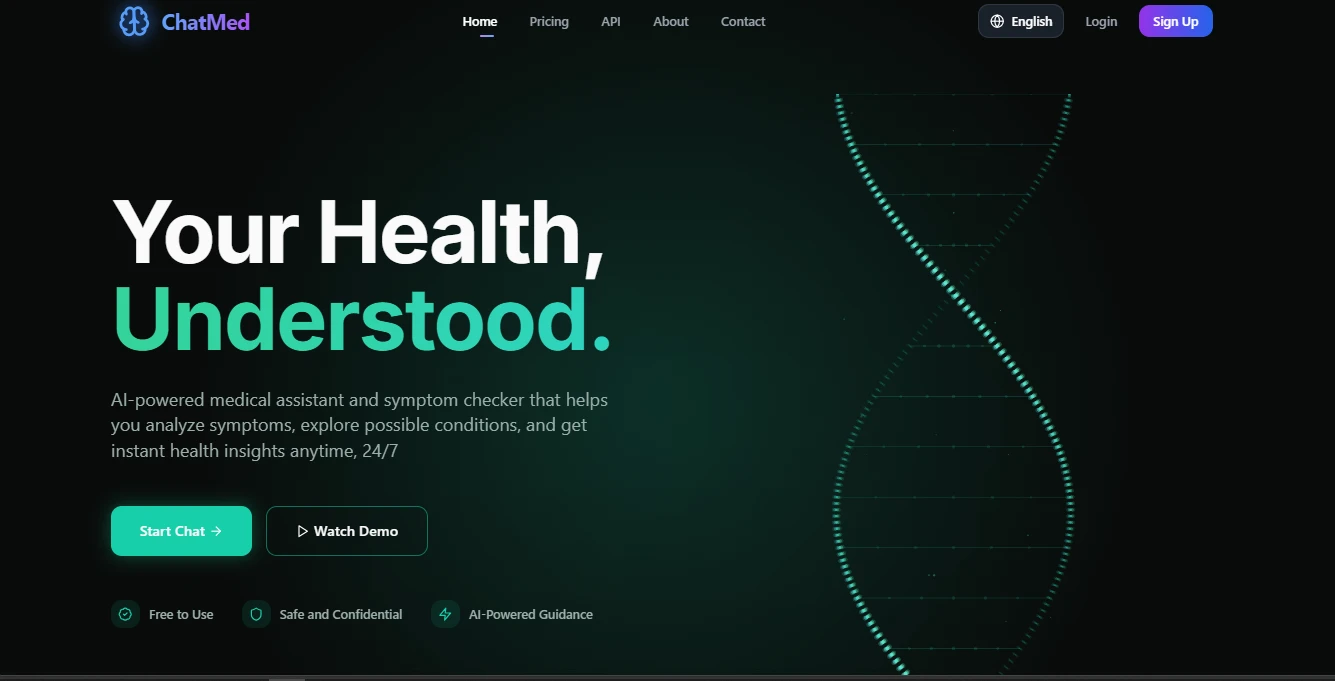
In terms of speed and accessibility, ChatMed is right at the front of the pack for 2026. While a lot of platforms want you to jump through hoops with expensive subscriptions, ChatMed skips the nonsense. You go to the site, describe your symptoms, and boom—you get a triage report, fast.
Why does ChatMed stand out?
Zero-Frustration Interface: No endless signup forms. Just a clean, efficient space where you tell the AI what’s going on, and it responds instantly.
Clinically Tuned: Unlike the generic chatbots floating around, ChatMed’s been trained on real medical data. That means it’s less likely to just make stuff up and more likely to give you safe, responsible advice.
Privacy Comes First: In healthcare, your data is sacred. ChatMed wraps your info in end-to-end encryption so nobody else gets a peek.
What’s it like to use? Picture a clean, white-and-blue chat window. Someone types, “I have a sharp pain in my lower right abdomen.” Instantly, the AI asks smart follow-up questions—about fever, nausea—just like a triage nurse would
We’ve dug into the other major players, too. Each one has its own vibe and purpose in the healthcare world.
2. Ada Health (The Global Leader)
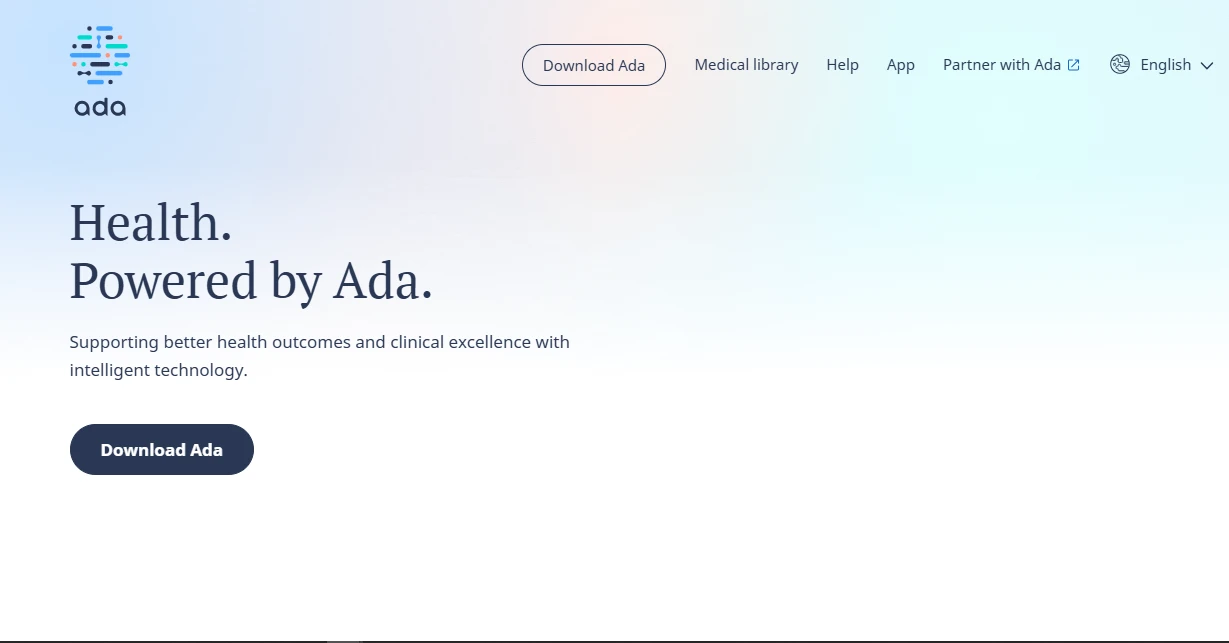
Ada’s a heavyweight. Its massive “Global Knowledge Base” packs wisdom from thousands of doctors.
Best if you want deep health assessments or want to keep track of symptoms over time.
And this isn’t just marketing—Ada gets cited in The Lancet for diagnostic accuracy that stacks up against junior doctors.
3. Glass Health (The Clinician’s AI)
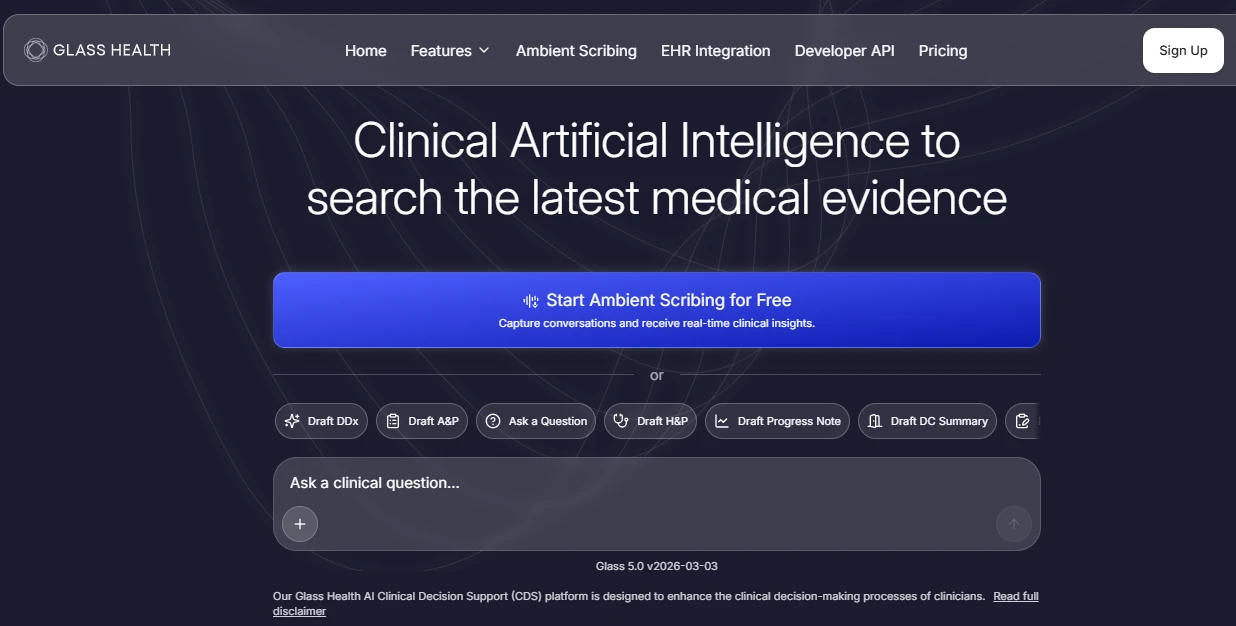
Glass Health is an AI-based clinical decision support chatbot and platform that is geared toward healthcare professionals. It enables healthcare professionals to quickly develop evidence-based differential diagnoses, write clinical assessment & plans, and answer complex medical reference questions by interpreting user input and searching authoritative medical literature. Glass Health can also interface with electronic health records and help healthcare professionals with ambient scribing in patient encounters. While other health chatbots are geared toward consumers, Glass Health is geared toward helping healthcare professionals with diagnostic, treatment, and documentation efficiency, including the use of peer-reviewed guidelines and AI-based responses.
4. Buoy Health (The Navigator)
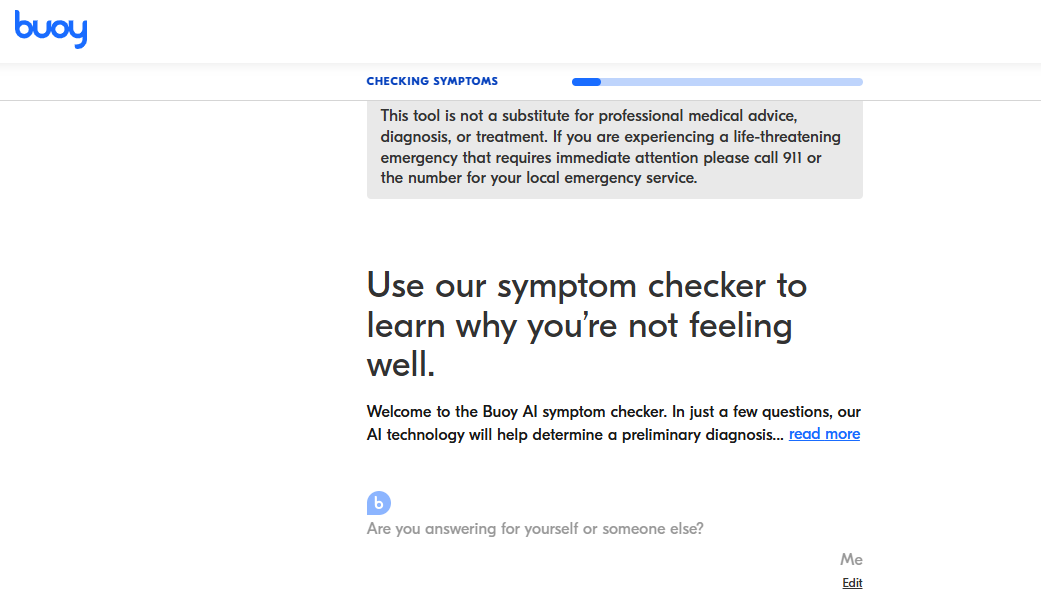
Buoy Health is an artificial intelligence-based symptom checker and health assistant that functions as a conversational doctor. It interacts with users in an engaging chat where it asks personalized questions about the symptoms in order to comprehend the situation as a whole. It then gives users possible causes, severity, and the best possible level of care, whether it is self-care at home, a primary doctor, urgent care, or emergency services. Its unique feature is e-triage, where users can reach the right endpoint for care in an efficient manner, as it has high diagnostic precision, avoiding unnecessary visits and helping users use the healthcare system correctly, as it is free, private, and doctor-developed with data from peer-reviewed sources.
4. Nabla Copilot
Nabla Copilot is an ambient AI assistant and medical scribe designed for medical professionals, enabling them to listen to patients' conversations, either in person or virtually, and generate clinical notes in real-time. The tool’s specialty lies in its ability to generate medical notes faster than any other tool on the market, offering support for over 55 medical specialties, such as internal medicine, pediatrics, oncology, psychiatry, orthopedics, and more, and accurately interpreting medical jargon, abbreviations, and complicated medical terminology due to its healthcare fine-tuned models.
Nabla Copilot’s ability to reduce the time spent on documentation by 50 percent or more, saving medical professionals hours of time each week, is one of its most significant advantages, in addition to reducing clinician burnout, enabling them to focus on their patients, and offering seamless integrations with most EHR systems, offering high levels of personalization, such as templates and instructions, and being available in multiple languages, such as English, French, and Spanish, and being HIPAA-compliant and offering high levels of data privacy.
5. Sunoh AI
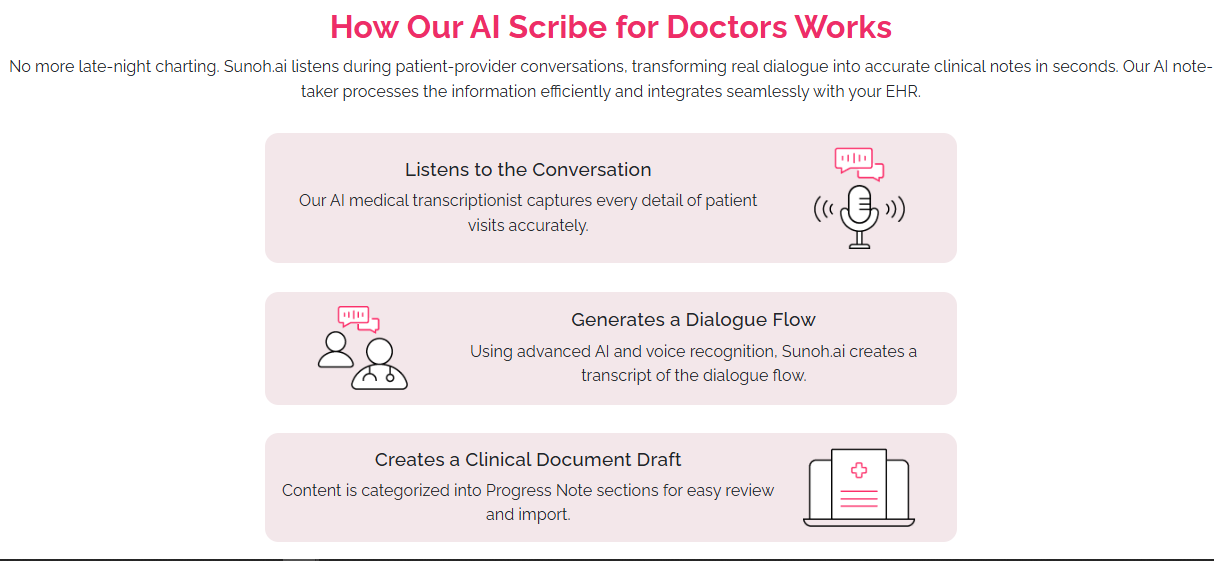
Sunoh AI is an ambient AI medical scribe that listens to real-time, natural patient-provider conversations (physical or virtual) and instantaneously creates accurate drafts of clinical documentation such as SOAP/progress notes, summaries, allergies (coded/uncoded), diagnoses, treatment plans, and pre-populated orders for medication, lab tests, imaging, referrals, etc. It’s fully integrated with EHRs (fully integrated with eClinicalWorks and agnostic for other EMRs), works on any device (PC, laptop, iPad, smartphone), and supports multilingual encounters (English, Spanish, Portuguese, Arabic, with more languages to be added soon). Its uniqueness is its extremely competitive pricing model ($149/user/month), with over 90,000+ providers trusting the product, its real-time documentation with high accuracy on complex medical terminologies across all specialties (family practice/general medicine, dermatology, rheumatology, behavioral health, dentistry, and many more), reducing provider burnout by saving 1-4+ hours daily on documentation, and providing customizable structured documentation for quick review and approval.
7. Suki AI
Suki AI is an advanced ambient clinical intelligence platform and AI assistant, not just a scribe, that listens in real-time to patient conversations, records the entire conversation, and automatically generates high-quality, specialty-specific structured notes, patient instructions, orders, and summaries with the ability to execute voice commands for editing, navigation, lookups, referrals, coding (ICD-10/HCC), and even answering clinical questions. It is available on desktop/mobile (iOS/Android) with deep integration with most EHRs (Epic, Athenahealth, Cerner, Meditech, etc.) and is designed to work with the clinician with problem-based charting and personalization. The speciality of Suki AI is its ability to cover 100+ specialties such as cardiology, oncology, pediatrics, psychiatry, neurosurgery, emergency medicine, and many more in outpatient, inpatient, and telehealth settings, thereby reducing documentation time by as much as 76%, burnout considerably, and resulting in revenue growth with coding accuracy, as well as offering an end-to-end workflow automation as a true AI assistant.
8. Nuance DAX Copilot (Microsoft)
Nuance DAX Copilot, now Microsoft Dragon Copilot, is an advanced ambient AI clinical assistant that securely captures multiparty patient conversations via mobile app, then uses generative AI to automatically generate specialty-specific, structured draft notes (including HPI, ROS, PE, A/P), orders, referral letters, after-visit summaries, evidence summaries, and problem-based charting. Its speciality lies in deep Epic integration for seamless in-workflow use, broad support across numerous specialties with optimized models, high accuracy from 10M+ trained encounters, customizable styles/formatting, AI coaching for note quality, multilingual capabilities (English/Spanish), and proven reductions in documentation time/burnout—freeing clinicians for better patient focus while boosting efficiency and revenue in ambulatory, urgent care, and telehealth settings.
9. Viz AI
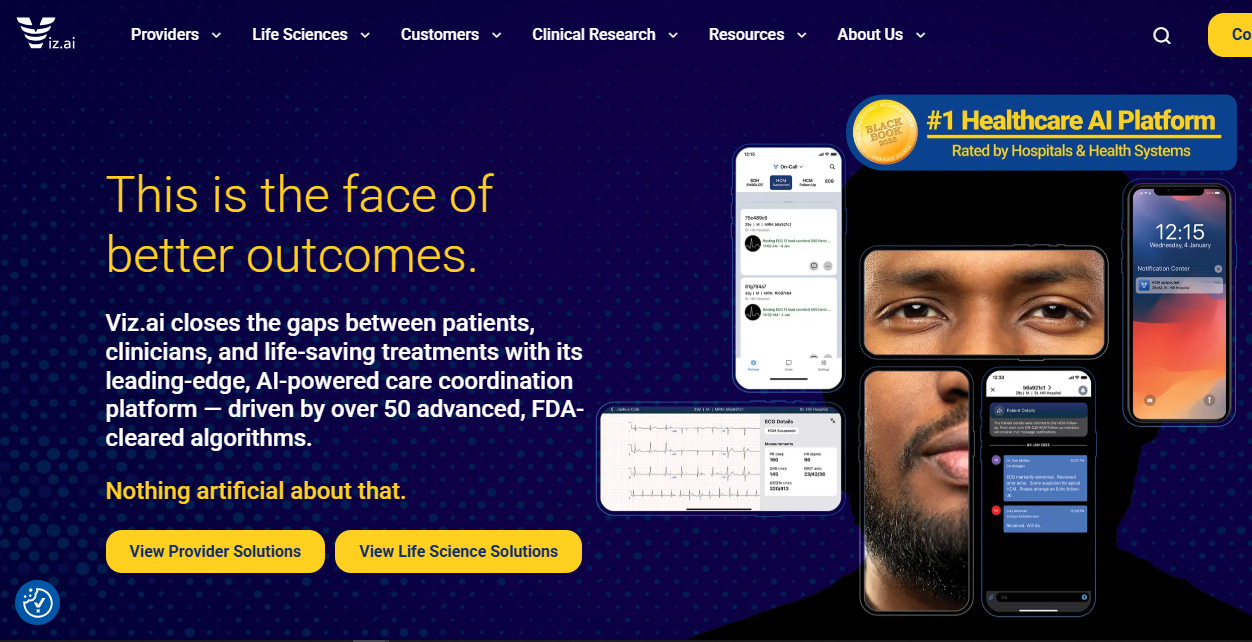
Viz.ai (now Viz.ai One) is an AI-based care coordination platform that enables real-time medical imaging analysis (CT, MRI, EKG, echocardiograms, etc.) using over 50 FDA-cleared algorithms to auto-detect diseases and accelerate diagnosis and treatment. It also enables real-time team synchronization across multiple teams and departments using mobile/desktop notifications, chat, and workflow integrations (EHR, PACS). The key differentiator is its ability to handle time-critical care situations in multiple specialties, including neurology (stroke LVO, hemorrhage), cardiology (PE, HCM), vascular, oncology, rare diseases, and emerging fields like Alzheimer’s, COPD, and more, and is trusted by 1700+ hospitals and supported by significant clinical evidence, reducing delays and improving outcomes, and facilitating life sciences collaborations for access to therapies.
10. Infermedica
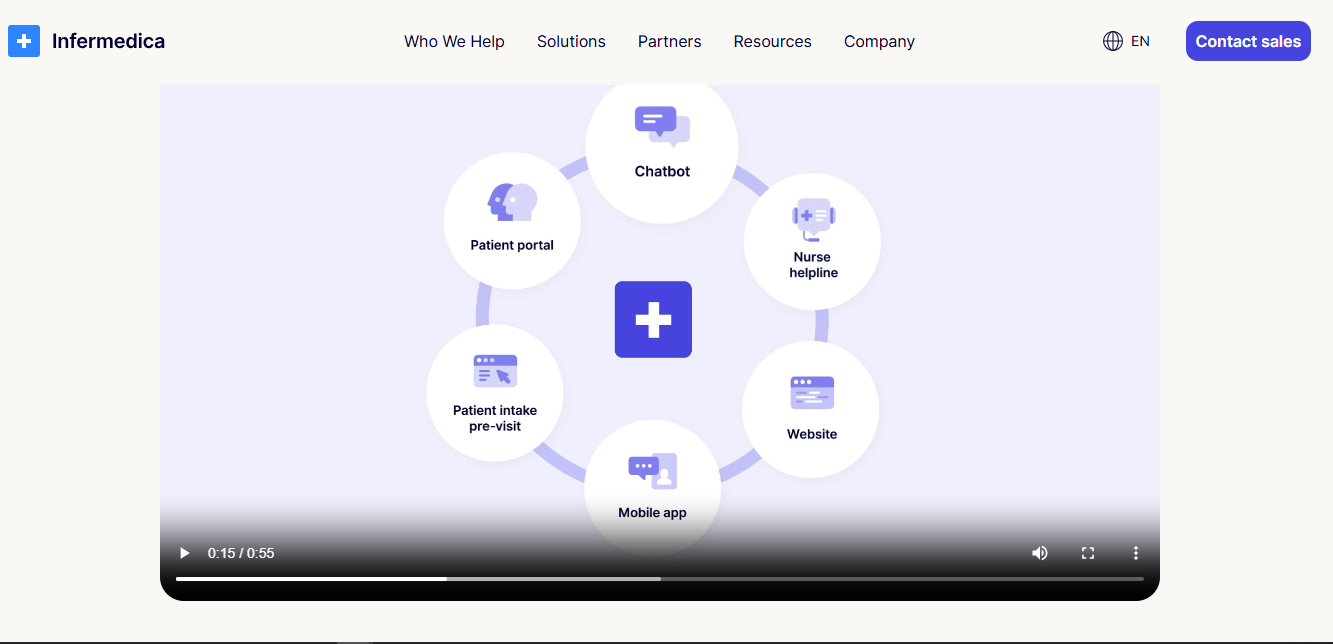
Infermedica is an AI-powered Medical Guidance Platform featuring a clinically validated symptom checker and virtual triage tool. It engages users in dynamic, conversational interviews (with NLP for natural language inputs), analyzes symptoms, risk factors, and history using a probabilistic inference engine, then provides accurate condition suggestions, urgency assessment, and personalized care navigation—guiding to self-care, telemedicine, urgent care, or emergency. Its speciality lies in high accuracy (94-95%), coverage of 800+ conditions and broad specialties, explainable reasoning for trust, MDR Class IIb certification, multilingual support (26+ languages), 24/7 omnichannel access, and integrations for patient intake, nurse co-pilot, and public health—reducing unnecessary visits, improving outcomes, and easing healthcare system burden.
11. Powerful Medical
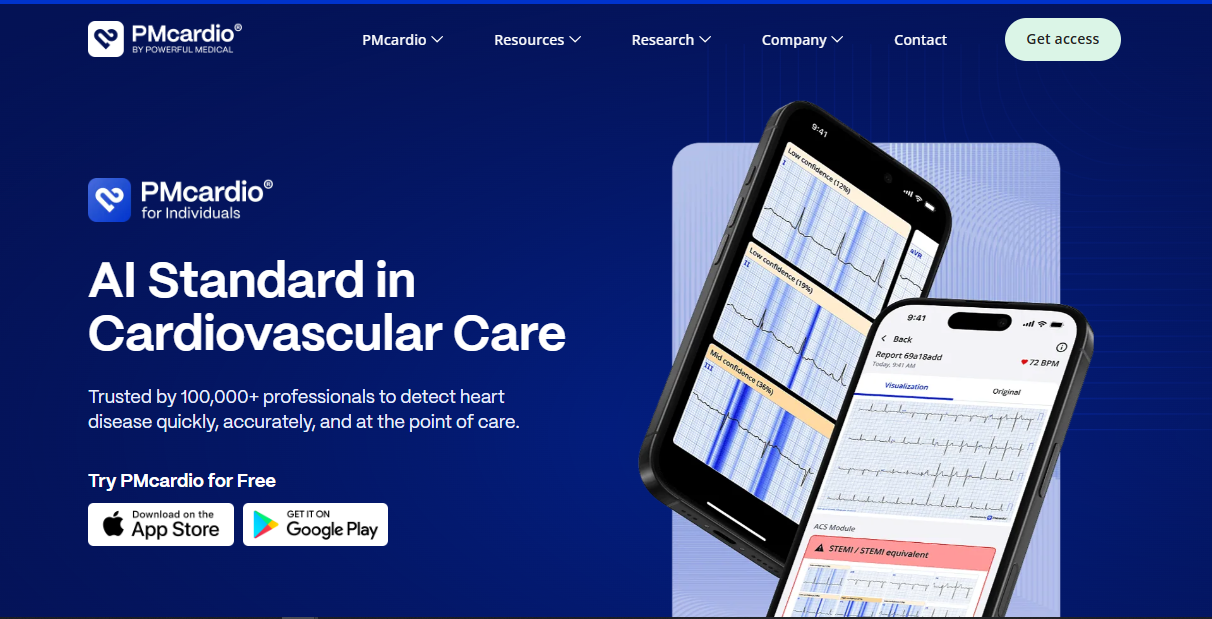
Powerful Medical's flagship PMcardio is an AI-powered ECG interpretation platform and certified medical device that analyzes 12-lead ECG images (snap a photo or upload) in seconds to detect over 48 cardiac abnormalities, including acute heart attacks (STEMI and equivalents/OMIs), heart failure, arrhythmias, and more—with higher accuracy than standard methods (twice the sensitivity, earlier detection by up to 3 hours). Its speciality lies in the Queen of Hearts™ model outperforming physicians in STEMI detection (FDA Breakthrough Device), explainable AI features, clinical validation in 15+ studies on millions of records, point-of-care use for emergency physicians, GPs, nurses, and cardiologists, mobile app availability, care coordination integration, and trusted by 100,000+ professionals to enable rapid, accurate triage and save lives in cardiovascular care.
12. Hippocratic AI
Hippocratic AI develops the safest generative AI agents for non-diagnostic, non-prescribing healthcare tasks using a novel 4.1T+ parameter constellation architecture with specialized support models for superior medical accuracy, safety, and empathy inference in natural voice conversations. Its speciality lies in patient-facing agents for low-risk interactions (e.g., engagement, follow-up, education, operational support), clinical validation on outputs, an app store for clinicians to build/share custom agents, partnerships with major health systems/life sciences, voice-enabled empathy to combat workforce shortages, HIPAA compliance, and scaling abundant, equitable care without replacing clinicians—focusing on improving access, outcomes, and reducing burnout.